Jl. Semolowaru no. 45 Surabaya
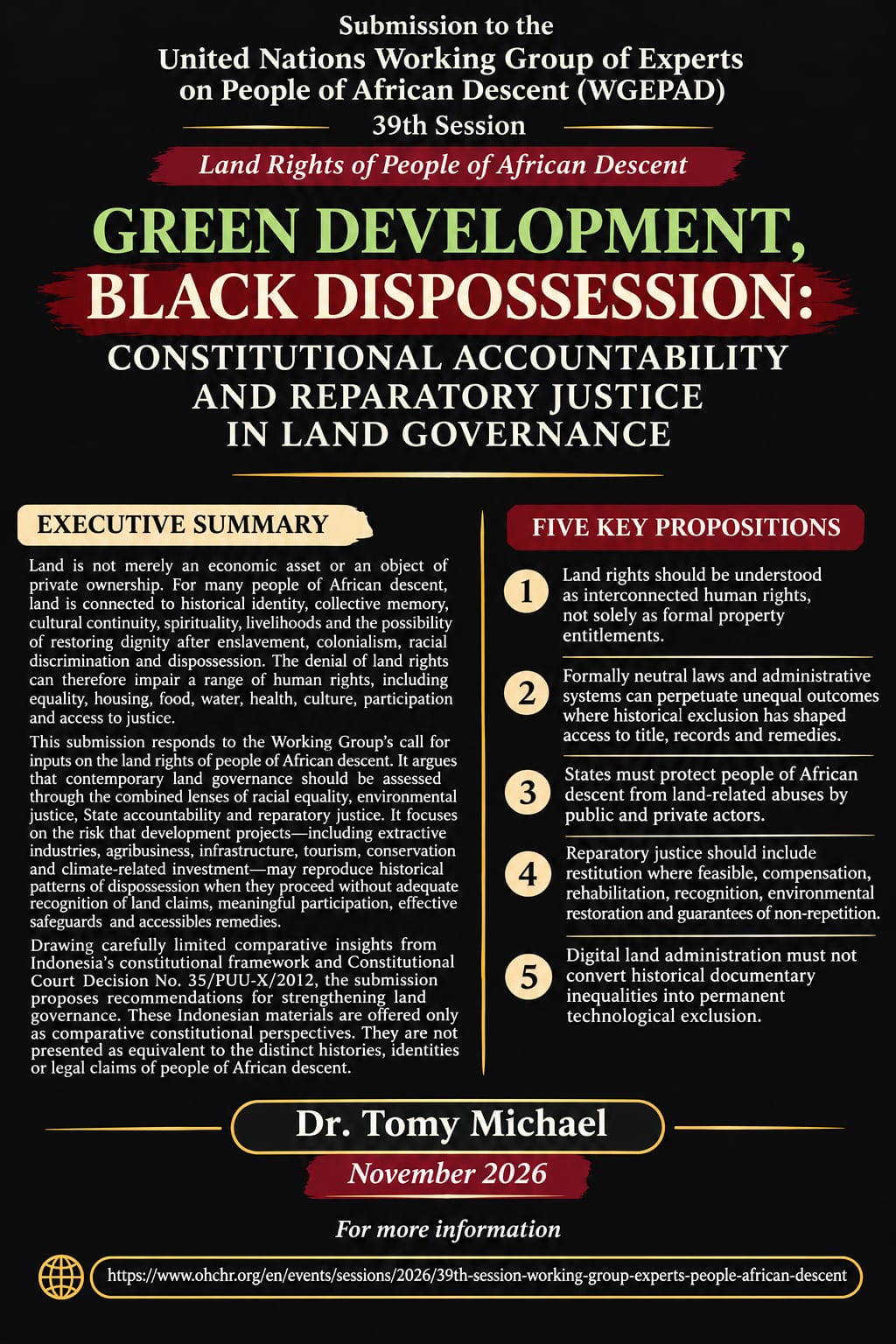
Submission to the United Nations Working Group of Experts on People of African Descent (WGEPAD) 39th Session
22
Nov
Submission to the United Nations Working Group of Experts on People of African Descent (WGEPAD) 39th Session
Land Rights of People of African Descent
EXECUTIVE SUMMARY
Land is not merely an economic asset or an object of private ownership. For many people of African descent, land is connected to historical identity, collective memory, cultural continuity, spirituality, livelihoods and the possibility of restoring dignity after enslavement, colonialism, racial discrimination and dispossession. The denial of land rights can therefore impair a range of human rights, including equality, housing, food, water, health, culture, participation and access to justice.
This submission responds to the Working Group’s call for inputs on the land rights of people of African descent. It argues that contemporary land governance should be assessed through the combined lenses of racial equality, environmental justice, State accountability and reparatory justice. It focuses on the risk that development projects—including extractive industries, agribusiness, infrastructure, tourism, conservation and climate-related investment—may reproduce historical patterns of dispossession when they proceed without adequate recognition of land claims, meaningful participation, effective safeguards and accessible remedies.
Drawing carefully limited comparative insights from Indonesia’s constitutional framework and Constitutional Court Decision No. 35/PUU-X/2012, the submission proposes recommendations for strengthening land governance. These Indonesian materials are offered only as comparative constitutional perspectives. They are not presented as equivalent to the distinct histories, identities or legal claims of people of African descent.
FIVE KEY PROPOSITIONS
1. Land rights should be understood as interconnected human rights, not solely as formal property entitlements.
2. Formally neutral laws and administrative systems can perpetuate unequal outcomes where historical exclusion has shaped access to title, records and remedies.
3. States must protect people of African descent from land-related abuses by public and private actors.
4. Reparatory justice should include restitution where feasible, compensation, rehabilitation, recognition, environmental restoration and guarantees of non-repetition.
5. Digital land administration must not convert historical documentary inequalities into permanent technological exclusion.
Dr. Tomy Michael
November 2026
For more information:
Berita Terbaru